Signed in as:
filler@godaddy.com

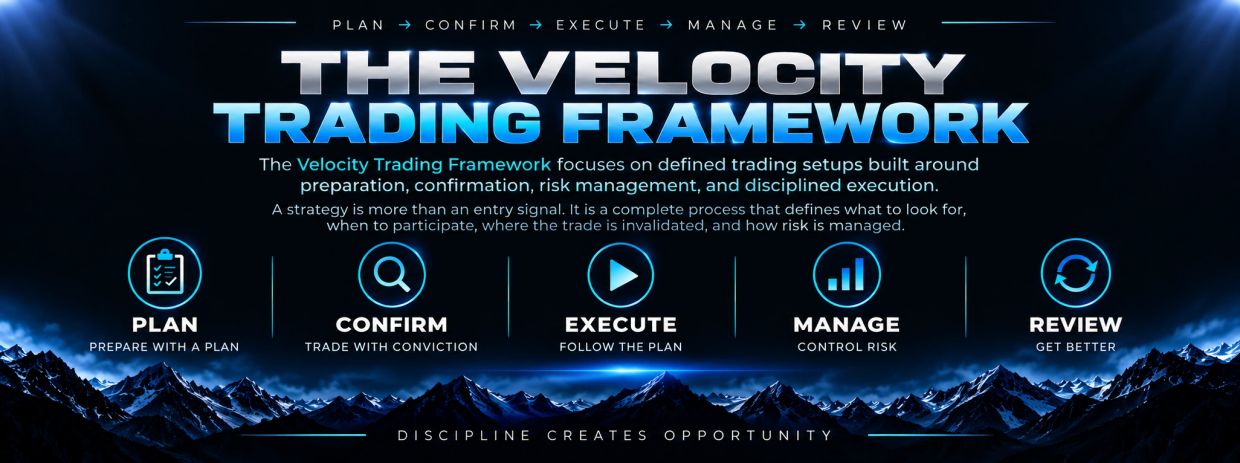
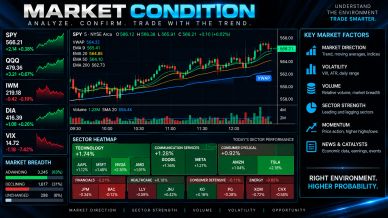
Understand the environment before selecting a strategy. Evaluate market direction, volatility, volume, sector strength, and overall momentum to determine which setups are aligned with current conditions.
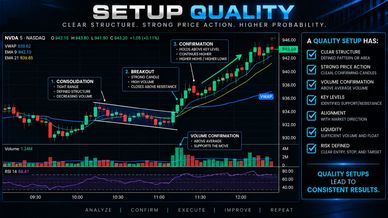
Look for clear structure, strong price action, confirmation, liquidity, and defined key levels. A setup should meet your rules before an entry is considered.

Define the entry, stop loss, profit target, position size, and invalidation level before execution. Every trade should have a clear risk plan before capital is committed.
WHAT IT IS
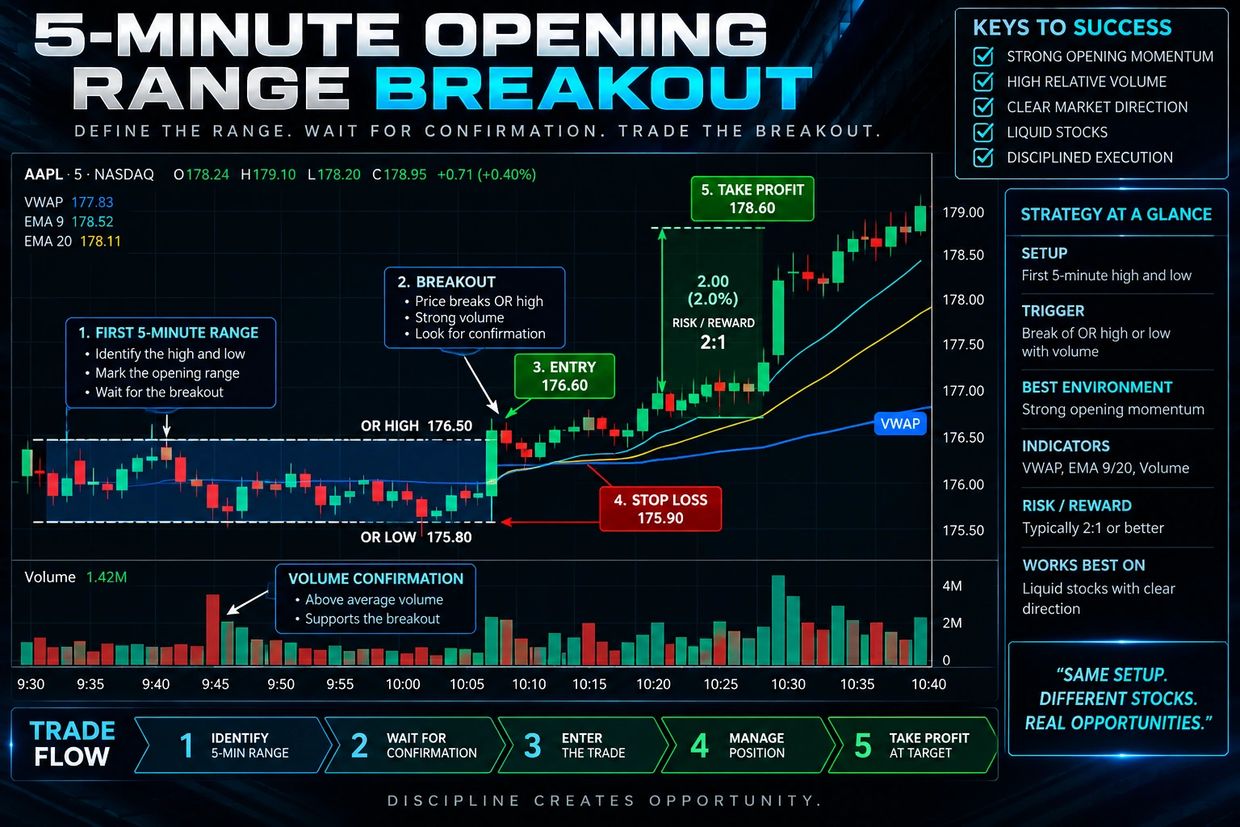
The 5-Minute Opening Range Breakout (ORB) identifies the high and low established during the first five minutes of regular market trading. A confirmed break beyond that range can signal the beginning of a directional move.
WHEN TO LOOK FOR IT
The ORB is most useful when a stock has strong opening momentum, above-average volume, a clear catalyst or reason for movement, and sufficient liquidity to support the trade.
SETUP REQUIREMENTS
• Establish the first 5-minute high and low.
• Mark the opening range on the chart.
• Identify nearby support and resistance.
• Watch for increasing volume as price approaches the range boundary.
• Evaluate the broader market and sector direction.
• Wait for confirmation before entering.
ENTRY
For a long setup, look for a confirmed break above the opening-range high with supporting volume and price action.
For a short setup, look for a confirmed break below the opening-range low with supporting volume and price action.
STOP LOSS
Define the invalidation level before entering. The stop should be based on the structure of the setup rather than an arbitrary price.
PROFIT TARGET
Identify the next meaningful price level before execution. Manage the position according to the planned risk and target rather than reacting emotionally during the trade.
WHAT TO AVOID
Avoid chasing extended candles, trading low-volume breakouts, entering without confirmation, ignoring broader market conditions, or taking a setup that does not provide clearly defined risk.
☐ First 5-minute range is clearly established
☐ Opening-range high and low are marked
☐ Volume supports the breakout
☐ Market/sector direction is supportive
☐ Entry is clearly defined
☐ Stop loss is defined before entry
☐ Profit target is defined
☐ Risk/reward is acceptable
☐ Price has not become excessively extended
☐ Trade fits the plan
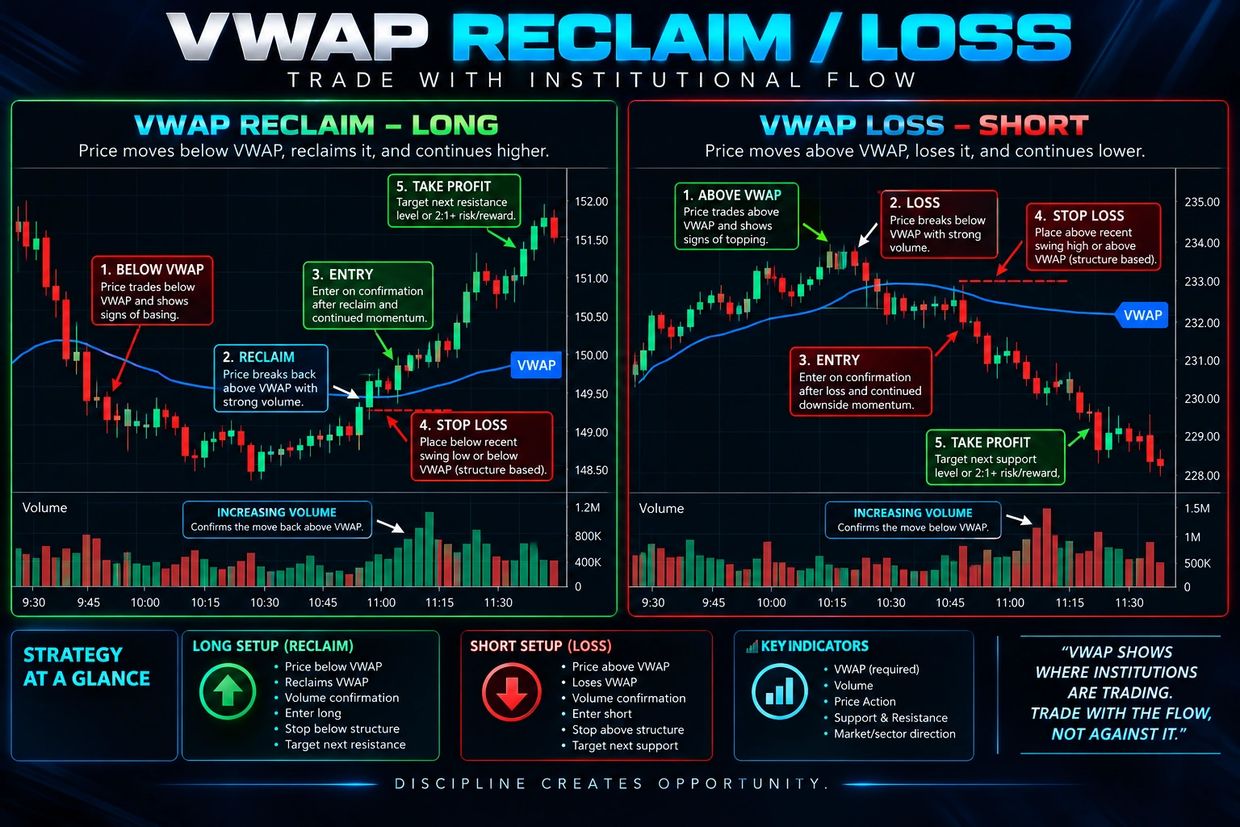
VWAP (Volume Weighted Average Price) represents the average price traded throughout the session, weighted by volume. A VWAP reclaim occurs when price moves back above VWAP and confirms strength. A VWAP loss occurs when price moves below VWAP and confirms weakness.
This setup is most useful when a stock has clear intraday direction, strong volume, sufficient liquidity, and meaningful price movement around VWAP.
LONG — VWAP RECLAIM
Enter after price reclaims VWAP and confirms continued strength through price action and volume.
SHORT — VWAP LOSS
Enter after price loses VWAP and confirms continued weakness through price action and volume.
Define the invalidation level before entry. For a long, the stop can be based on recent structure or a failed VWAP reclaim. For a short, the stop can be based on recent structure or a failed VWAP loss.
Identify the next meaningful support or resistance level before entering. Consider the available risk/reward and manage the position according to the trading plan.
Avoid entering on the first touch of VWAP without confirmation, trading during choppy VWAP whipsaws, ignoring volume, chasing extended moves, or entering when market conditions do not support the setup.
☐ VWAP is clearly identified
☐ Price action shows a clear reclaim or loss
☐ Volume confirms the move
☐ Market/sector direction is supportive
☐ Key support and resistance are identified
☐ Entry is clearly defined
☐ Stop loss is defined before entry
☐ Profit target is defined
☐ Risk/reward is acceptable
☐ Trade fits the plan
FOLLOW THE FLOW. WAIT FOR CONFIRMATION. EXECUTE WITH DISCIPLINE.
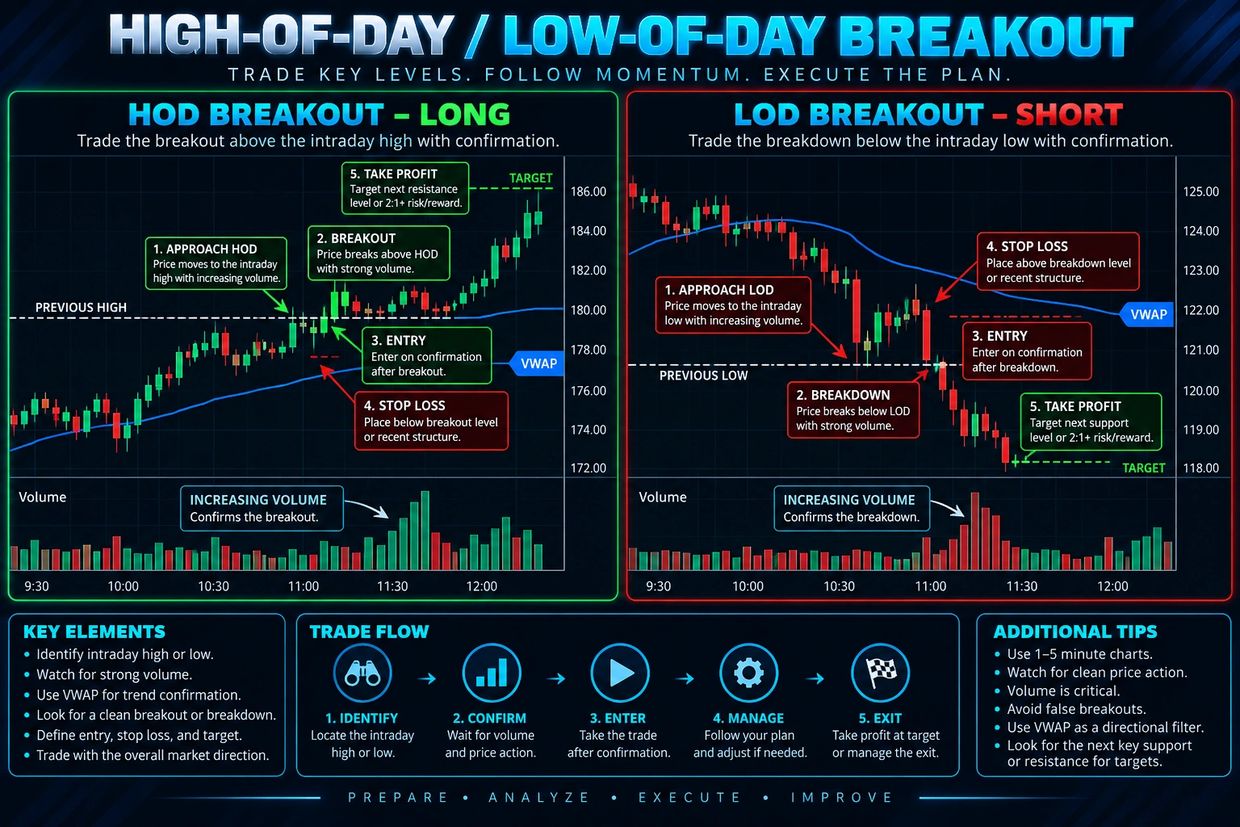
A High-of-Day (HOD) or Low-of-Day (LOD) breakout occurs when price breaks through an established intraday high or low with confirmation. These levels can act as important decision points because a clean break can signal continued momentum.
Look for HOD/LOD setups when a stock has strong momentum, above-average volume, clear market direction, and enough liquidity to support a clean breakout or breakdown.
LONG — HOD BREAKOUT
Enter after price breaks above the High of Day with confirmation from price action and volume.
SHORT — LOD BREAKDOWN
Enter after price breaks below the Low of Day with confirmation from price action and volume.
Define the invalidation level before entry. For a long, the stop can be placed below the breakout structure or another clearly defined support level. For a short, the stop can be placed above the breakdown structure or defined resistance level.
Identify the next meaningful support or resistance level before entering. Consider the available risk/reward and manage the position according to the trading plan.
Avoid chasing extended breakouts, entering without volume confirmation, trading levels that lack clear price action, ignoring broader market direction, or entering after the move has become excessively extended.
☐ HOD or LOD is clearly identified
☐ Price is approaching the level with momentum
☐ Volume supports the breakout/breakdown
☐ Market and sector direction are supportive
☐ VWAP provides useful directional context
☐ Entry is clearly defined
☐ Stop loss is defined before entry
☐ Profit target is defined
☐ Risk/reward is acceptable
☐ Price is not excessively extended
☐ Trade fits the plan
KNOW THE LEVEL. WAIT FOR CONFIRMATION. TRADE THE MOVE.
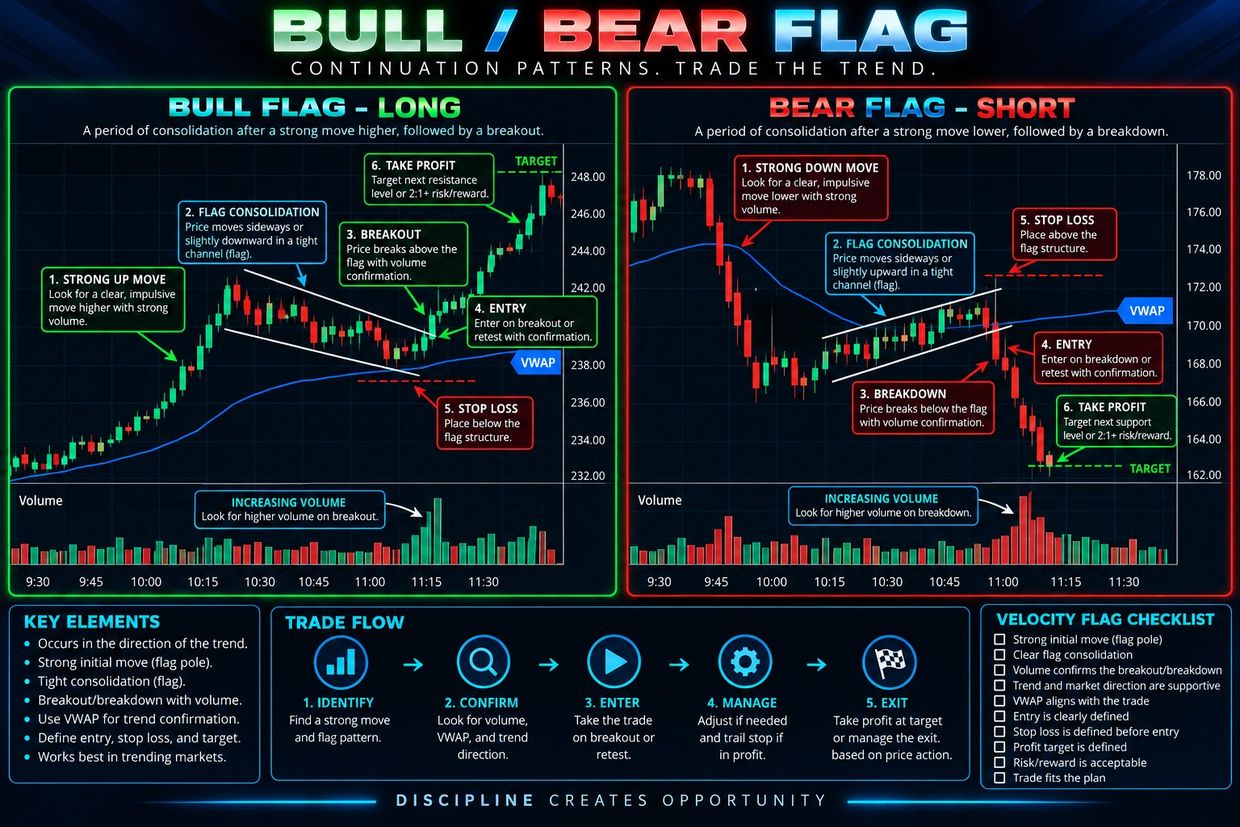
A bull or bear flag is a continuation pattern that develops after a strong directional move. Price consolidates in a relatively tight structure before breaking in the direction of the prevailing trend.
Look for flags after a strong momentum move with elevated volume, clear trend direction, and orderly consolidation. The pattern is most useful when the broader market and sector support the direction of the trade.
LONG — BULL FLAG
Enter after price breaks above the flag structure with confirmation from price action and volume.
SHORT — BEAR FLAG
Enter after price breaks below the flag structure with confirmation from price action and volume.
Define the invalidation level before entering. For a bull flag, the stop can be based below the flag structure or another clearly defined support level. For a bear flag, the stop can be based above the flag structure or defined resistance.
Identify the next meaningful support or resistance level before entering. Consider the available risk/reward and manage the trade according to the plan.
Avoid flags that are too wide or choppy, weak initial moves, declining momentum without confirmation, low-volume breakouts, chasing extended candles, and setups that conflict with the broader market direction.
☐ Strong initial move / flagpole is present
☐ Clear flag consolidation
☐ Trend direction is established
☐ Volume supports the breakout/breakdown
☐ VWAP aligns with the trade
☐ Market and sector direction are supportive
☐ Entry is clearly defined
☐ Stop loss is defined before entry
☐ Profit target is defined
☐ Risk/reward is acceptable
☐ Trade fits the plan
FIND THE TREND. WAIT FOR THE FLAG. TRADE THE BREAK.
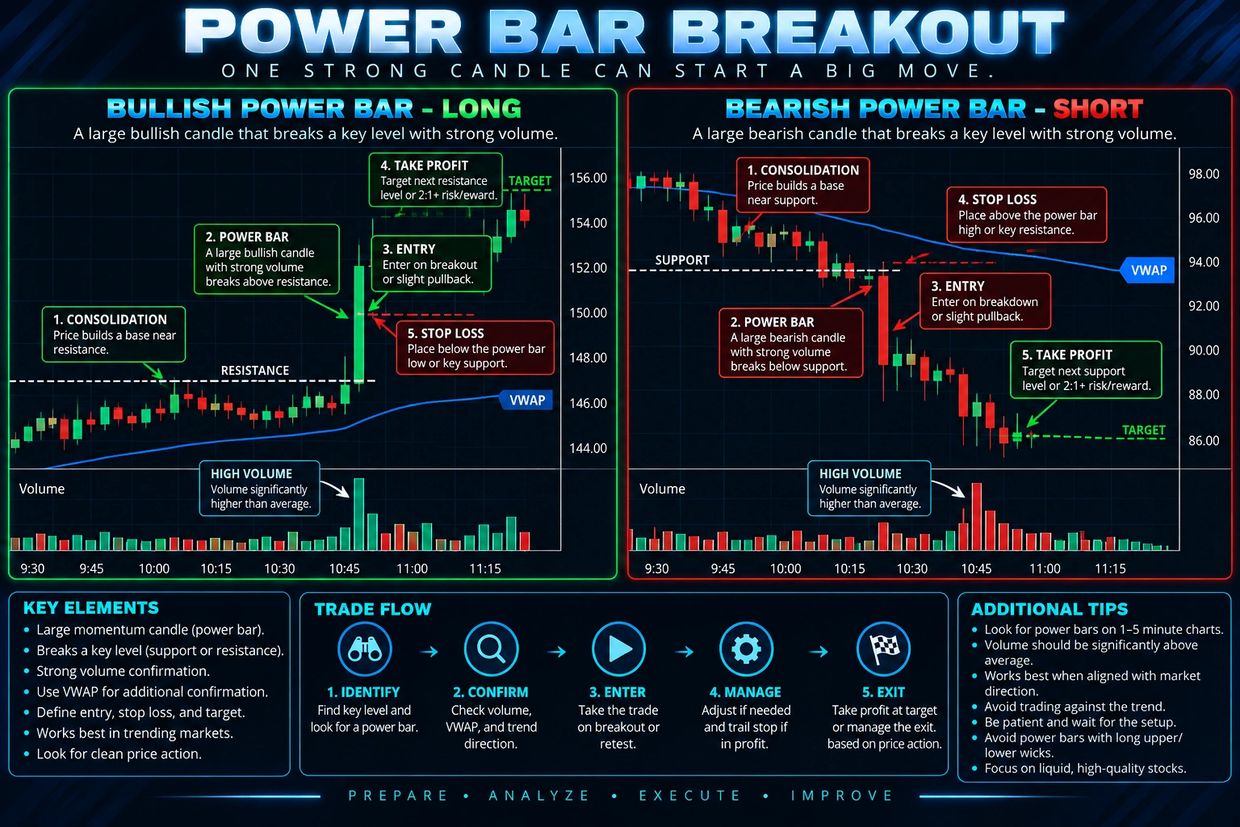
A Power Bar Breakout occurs when a large momentum candle breaks through an important support or resistance level with significantly higher-than-average volume. The candle demonstrates strong buying or selling pressure and can signal the start or continuation of a larger move.
Look for Power Bar setups when a stock has strong momentum, clear key levels, elevated volume, and a market environment that supports the direction of the move.
LONG — BULLISH POWER BAR
Enter when a strong bullish candle breaks above resistance with volume confirmation. A controlled pullback or retest can provide an alternative entry when appropriate.
SHORT — BEARISH POWER BAR
Enter when a strong bearish candle breaks below support with volume confirmation. A controlled retest can provide an alternative entry when appropriate.
Define the invalidation level before entering. For a long, the stop can be placed below the Power Bar structure or key support. For a short, the stop can be placed above the Power Bar structure or key resistance.
Identify the next meaningful support or resistance level before entry. Consider the available risk/reward and manage the position according to the trading plan.
Avoid weak candles, low-volume breaks, excessive upper or lower wicks, chasing an already extended move, trading against the broader trend, and entering before confirmation.
☐ Key support or resistance is clearly identified
☐ Consolidation or compression is present
☐ Power Bar shows strong momentum
☐ Volume is significantly above average
☐ VWAP supports the trade direction
☐ Market and sector direction are supportive
☐ Entry is clearly defined
☐ Stop loss is defined before entry
☐ Profit target is defined
☐ Risk/reward is acceptable
☐ Price is not excessively extended
☐ Trade fits the plan
IDENTIFY THE LEVEL. WAIT FOR THE POWER BAR. TRADE THE CONFIRMATION.
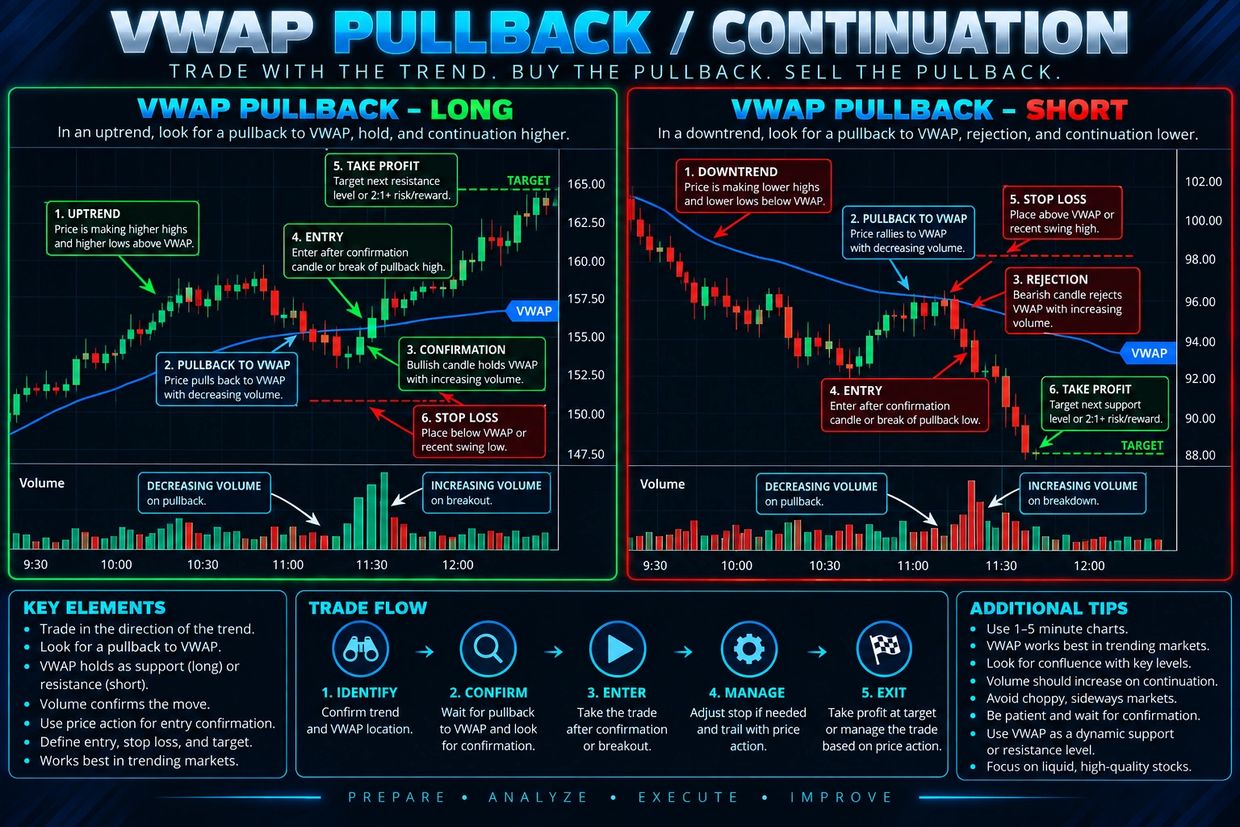
A VWAP Pullback / Continuation setup occurs when a stock is already moving in a defined intraday trend, pulls back toward VWAP, holds the level, and then resumes in the direction of the trend.
Look for this setup when a stock has a clear trend, strong liquidity, sustained volume, and orderly pullbacks toward VWAP. It works best when the broader market and sector support the direction of the trade.
LONG — VWAP PULLBACK
Enter after price pulls back toward VWAP, holds the level, and confirms renewed buying pressure.
SHORT — VWAP PULLBACK
Enter after price rallies toward VWAP, rejects the level, and confirms renewed selling pressure.
Define the invalidation level before entry. For a long, the stop can be placed below VWAP or the recent swing low. For a short, the stop can be placed above VWAP or the recent swing high.
Target the next meaningful support or resistance level while maintaining an acceptable risk/reward. Manage the trade as price action develops.
Avoid choppy sideways markets, weak trends, VWAP whipsaws, low-volume continuation attempts, chasing extended moves, and trades that lack confirmation.
☐ Clear trend is established
☐ Price is respecting VWAP
☐ Pullback toward VWAP is orderly
☐ Volume decreases during the pullback
☐ VWAP holds as support/resistance
☐ Confirmation candle is present
☐ Volume increases on continuation
☐ Entry is clearly defined
☐ Stop loss is defined before entry
☐ Profit target is defined
☐ Risk/reward is acceptable
☐ Trade fits the plan
TRADE WITH THE TREND. WAIT FOR THE PULLBACK. CONFIRM THE CONTINUATION.